
Harrisburg Previous Residents by Era
Previous residents of a Harrisburg address are best traced with an era table before any conclusion is made. The Recorder supplies the long recorded-title trail. HSDC directories place a listed person or business at an address in selected years. Sanborn maps check a structure and street configuration, while released census material checks a household in its own census era. Vital, obituary, and estate evidence can explain a departure or connect a decedent to a personal representative or heir. City permit and code files are a separate project-history channel, available by a narrow City request under the Pennsylvania Right-to-Know Law (RTKL), Act 3 of 2008, 65 P.S. §§ 67.101–67.3104, rather than a public permit index.
| Source | Years it covers | Where held | What it shows |
|---|---|---|---|
| Recorder deeds and miscellaneous documents | 1785–present | Dauphin Recorder Acclaim and counter | Recorded parties, title trail, legal description, document placement |
| Recorder mortgages | 1979–present | Dauphin Recorder Acclaim and counter | Mortgage and satisfaction part of the property trail |
| HSDC city directories | 1839, 1842, 1843, 1852, 1856, 1858, 1860, 1863–64, 1866–67, 1869; 1871–1947; 1949–56; 1958–76; 1979–82; 1986–99 | HSDC library and query route | Dated name, address, usually occupation; some street-number arrangements |
| Sanborn volume | 1929–November 1950 | Library of Congress digitized collection | Structure, street, and block context in the mapped period |
| Pre-1906 local vital registers | 1852–54 returns; 1893–1905 county-register context | State Archives and Register of Wills | Early family clues that require local-record verification |
| Federal census | Released schedules under the 72-year practice | Federal and National Archives channels | Household, age, relationship, and era-based address evidence |
| City permit or code files | No published online date range located | Harrisburg Codes or targeted RTKL request | Building or project history after a specific request |
Harrisburg gaps matter. The directory runs are not continuous, so a missing listing in an unheld year says nothing. Likewise, a map can show a building without naming a household, and a recorded owner can be different from the person named in a directory.
Start Harrisburg Previous Residents at the Parcel
Start a Harrisburg previous-residents search in Dauphin Property Tax Inquiry with the current address, a parcel number, or an owner name as printed on the tax bill. The result is a current assessment account. Preserve the Property ID or UPI, current owner, tax mailing address, situs address, property characteristics, and deed reference before opening another system. The tax mailing address belongs to the account and can differ from the parcel location. Neither it nor the situs identifies every household that has occupied the property.
The current account is only the starting pin. It is valuable because the same UPI can be searched in the Recorder system and compared with the legal description in a deed. The full current-address workflow belongs on the Harrisburg by-street directory page; the aim here is to step backward from today’s parcel without assuming that a modern number explains an earlier one.
Note: Record the returned situs form and the exact tax-search wording, because historic directories may use a different directional, suffix, or number range.
Walk the Harrisburg Deed Chain Backward
Dauphin County’s Acclaim record search is the recorded-document spine for past-address research about a Harrisburg parcel. It supports UPI, name, instrument number, document type, book/page, record-date, consideration, municipality/comments, and Alpha Index routes. The Recorder states that deeds and miscellaneous documents extend from 1785 to the present and mortgages from 1979 to the present. That deep coverage creates a long possible title trail, but the search must follow a transfer, not a repeated street number.
- Use the current parcel’s UPI, deed reference, or owner name to find the current purchase document in Acclaim.
- Copy the buyer or grantee, seller or grantor, recording date, book/page or instrument number, legal description, and any stated earlier reference.
- Search the seller as a grantee to find that seller’s earlier purchase, or follow the deed’s prior reference.
- Compare the UPI, lot, block, subdivision, municipality, and legal description before treating two documents as the same Harrisburg property.
- Repeat one transfer at a time. When an older index is unclear, use the Alpha Index, obtain the document, or ask the Recorder counter about historical index navigation.
- Grantor
- The party transferring an interest in the recorded document. In the backward chain, that seller may lead to an earlier acquisition.
- Grantee
- The party receiving the recorded interest. Searching a prior seller as grantee can locate the preceding purchase.
- Chain of title
- The sequence of recorded transfers tied to the same property. It is a title trail, not a household roster.
- Legal description
- The lot, block, subdivision, metes, or other property description in a document. It is often safer than a reused street number for historic matching.
A past household is not automatically a prior owner. A deed establishes a recorded property transaction; a dated directory or released census schedule is needed for an occupant claim.
The Recorder’s UPI and parcel-number search is the direct bridge from the county property account to a recorded Harrisburg deed trail.
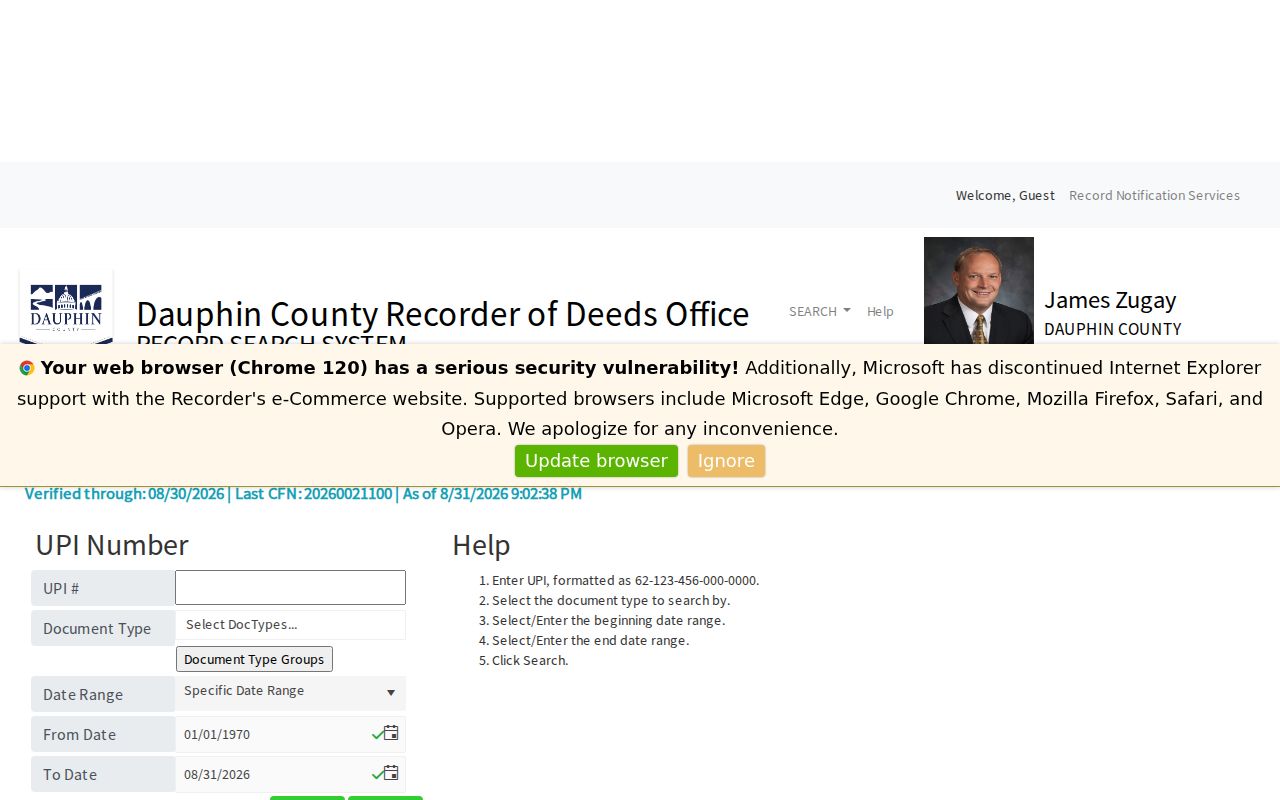
Using the same UPI across the assessment account and Recorder search helps separate a durable parcel trail from a street number that may have changed form.
The Recorder’s instrument-number search is useful once a deed, mortgage, or earlier document reference has been copied from the chain.
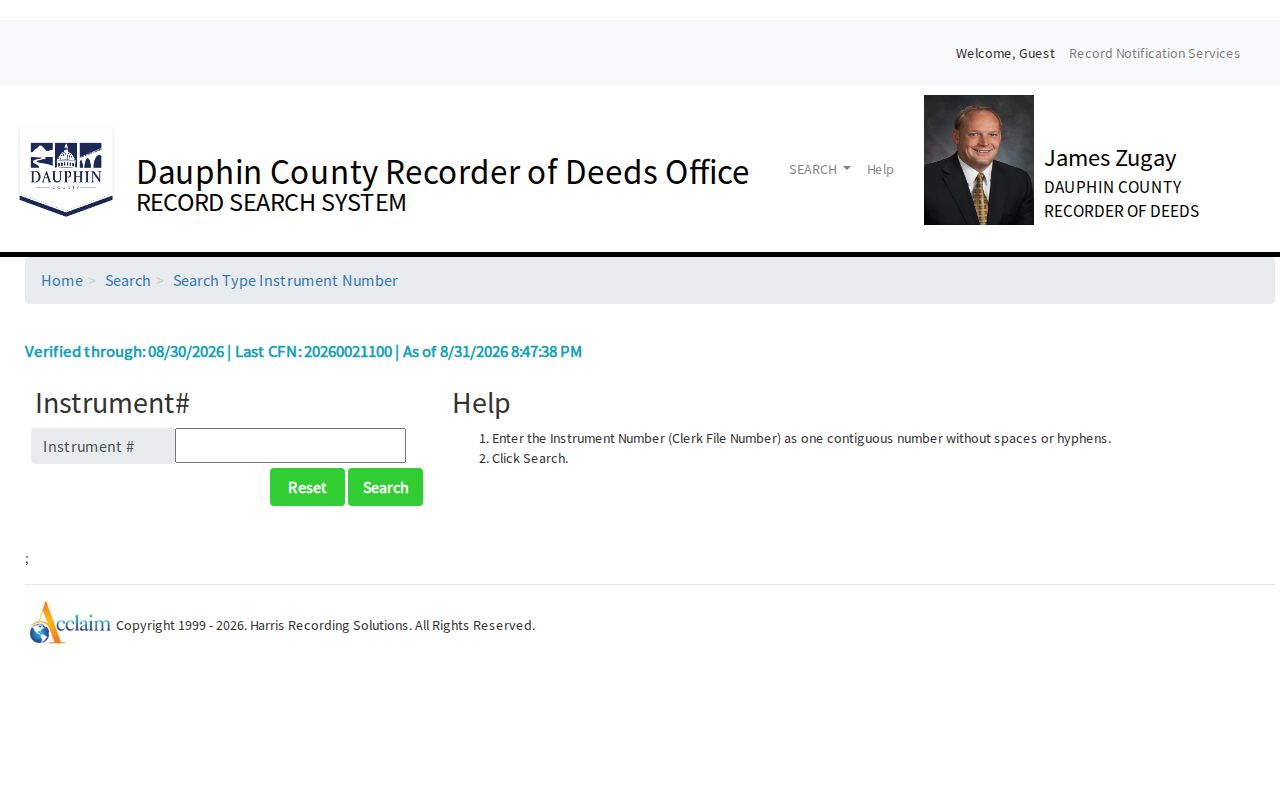
The instrument reference preserves the retrieval path for the specific recorded transfer being compared, rather than relying on a name match alone.
Match Harrisburg Addresses Beyond Numbers
When a Harrisburg address changes form, keep the legal description and UPI at the center of the comparison. Modern county search guidance prefers bare house number and street name without a directional or suffix. An old directory may print the complete form. A block may also be described differently across a street-name change, municipal heading, subdivision, map sheet, or city-boundary context. Compare adjacent streets and landmarks as supporting evidence, but do not treat a matching number as proof by itself.
Use a current postal form only as one label in the evidence log. Test an older Harrisburg address against the deed description, directory volume, and map year before treating the locations as the same parcel.
Pair Harrisburg Directories With Census Years
Directories and census schedules answer different parts of the previous-residents question. HSDC directory entries are dated listings that can show a name, address, and usually occupation. Some volumes have a street-number arrangement that starts from an address. Released federal census schedules provide a household, ages, relationships, and the census era. Search the directory’s alphabetical section and its street-number section when present, then compare the same address form with a released census schedule rather than treating either source as complete on its own.
- Choose an anchor year with a deed, parcel reference, address, or surname already documented.
- Locate the nearest actual HSDC directory volume. Record the volume’s date, geographic heading, spelling, address, and whether it has a reverse section.
- Move to the next earlier or later held volume, one actual publication at a time. Do not invent a listing for a directory gap.
- Pair the directory year with the released census era and compare household details, not just a name match.
- Use Sanborn maps, newspapers, obituaries, probate, or permits to test a move, death, ownership change, or structure change.
Some HSDC books cover nearby Steelton and Middletown as well as Harrisburg. Read the volume title and page heading before treating a listing as inside the City. This small geography check prevents a past-residents trail from drifting to a nearby community.
Respect Harrisburg Directory Gaps
HSDC holds Harrisburg volumes for 1839; 1842; 1843; 1852; 1856; 1858; 1860; 1863–64; 1866–67; 1869; 1871 through 1947; 1949 through 1956; 1958 through 1976; 1979 through 1982; and 1986 through 1999. That exact run is strong evidence for previous residents, and the interruptions are just as important. A person’s absence in 1948, 1957, 1977–78, or 1983–85 cannot be treated as a move from the address merely because the surrounding years are held.
HSDC is at 219 South Front Street in Harrisburg and lists a library phone number of 717-233-3462, a query route, and staff research options. The HSDC directory page is the source for the exact holdings. For a gap, ask the library or archives about other material rather than silently filling the missing year.
Note: A directory entry is a dated listing whose abbreviations and spelling should be copied exactly before it is compared with another record.
Test Harrisburg Houses on Sanborn Maps
Harrisburg’s Historic Preservation house-history guide is the best official map starting point for a prior-address question. It identifies 1884, 1890, 1905, and 1929 Sanborn editions and explains that they can reveal a footprint, materials, roof form, use, outbuildings, and later features. The City guide gives a direct address-continuity warning: what is now 107–109 Cumberland appears as 109–111 on the 1890 map. That is a reason to search map sheets and document context, not merely today’s number.
The Harrisburg Historic Preservation house-history and Sanborn guide links the local map approach to the City’s current resource. The 1929–November 1950 Library of Congress volume has 106 sheets and also names adjacent places in its coverage. A map confirms structure or street context; it does not identify every previous resident.

Harrisburg historic GIS layers for 1900, 1910, 1920, and 1930, together with the map editions and HSDC material, give an address researcher several ways to test continuity without inventing a citywide renumbering rule.
Read Harrisburg’s Old Eighth Ward Carefully
An address that disappears from later Harrisburg directories or maps is not always a simple household move. The Old Eighth Ward was a formerly African American, Jewish, and immigrant neighborhood displaced for Capitol Park extensions. The Digital Harrisburg exhibit describes a first clearance phase roughly between Walnut and North from 1913 to 1919 and later clearance in the 1950s. In that area, a changed street or missing later address can reflect displacement and a changing landscape.
Use the exhibit with ward maps, actual directory volumes, City records, and the deed or parcel trail. It is a local records-history explanation to test, not a shortcut for naming former household members. For a precise street rename, ward change, or municipal action, Harrisburg City Council and ordinance microfilm are the relevant historical record groups.
Finish Harrisburg Past Trails With Estates
When an owner or listed occupant leaves a Harrisburg address, a death index, obituary, or estate file may explain the change. The Dauphin Register of Wills and Clerk of Orphans’ Court is the local estate, marriage, public Orphans’ Court, and historical-records channel. Its Cloud Search offers estate, marriage, and public Orphans’ Court routes. The county reports estate material reaching into the late 1700s; registration and image viewing are available without charge, while current download or cart charges should be checked in the portal. The counter and phone are the fallback for a digitization or index gap.
For early family clues, 1852–54 returns are a State Archives series, and 1893–1905 county birth-register context is generally held through the Register of Wills or Clerk of Orphans’ Court. HSDC’s Alexander Family Library adds late-1700s to late-1800s newspaper-clipping cards for weddings and deaths, Dauphin birth/death cards for 1893–1906, cemetery inventories, Will Book extracts for 1785–1827, and Orphans’ Court extracts for 1785–1817. The State Library’s Harrisburg Newspapers Index covers birth, death, and marriage notices from 1799–1827 and includes Harrisburg Necrology Scrapbooks.
A Harrisburg estate file can bridge a decedent, a personal representative or heir, and a dated recorded-property trail. It does not establish an address for a living person, and an obituary is evidence to compare with the original custodian’s record.
Keep Harrisburg Previous-Resident Research Lawful
Use past-residents research for house history, family history, estate questions, and personal curiosity. Keep the conclusion no broader than the dated record supports. Public documents do not authorize repeated unwanted contact, threats, intimidation, harassment, or harm. Some addresses and records remain protected, and motor-vehicle information is not opened by a local records request. Pennsylvania’s Address Confidentiality Program and record-specific redactions also limit what may be disclosed.
When a records trail reaches a privacy boundary, preserve the dated evidence already held and use the original Harrisburg or Pennsylvania custodian for the appropriate next question.