
Harrisburg City Directory Collections at HSDC
The Historical Society of Dauphin County directory collection is the main local shelf for an HSDC directory search. Its verified run is unusually specific: 1839; 1842; 1843; 1852; 1856; 1858; 1860; 1863-64; 1866-67; 1869; 1871-1947; 1949-56; 1958-76; 1979-82; and 1986-99. The books list residents and businesses alphabetically, normally with an address and usually an occupation. This is a historic listing, not a modern identity record. It should be read alongside the title page, year, and geographic heading of the particular volume.
| Collection | Years | Where Held | Access |
|---|---|---|---|
| HSDC Harrisburg City Directories | 1839, 1842, 1843, 1852, 1856, 1858, 1860, 1863-64, 1866-67, 1869, 1871-1947, 1949-56, 1958-76, 1979-82, 1986-99 | Historical Society of Dauphin County | Library visit or research query |
| DCLS East Shore microfilm | 1861-1901 | East Shore Area Library, 4501 Ethel Street | Onsite only |
| HSDC Archives | Historical manuscript groups and maps | Historical Society archives | Query, onsite work, or research service |
| State Library digital genealogy collection | Harrisburg Newspapers Index, 1799-1827; other local material varies | Pennsylvania State Library collection | Digital collection and library research |
The early gaps are evidence, not blanks to be guessed away. The directory collection does not establish annual publication for 1840-41, 1844-51, 1853-55, 1857, 1859, 1861-62, 1865, 1868, 1948, 1957, 1977-78, 1983-85, or any other unlisted year. HSDC is at 219 South Front Street, Harrisburg, PA 17104, and lists 717-233-3462 for the library. Ask about the exact book, handling rules, and current research-service options before making a special trip.
The HSDC directory page is also the source for this captured collection view.
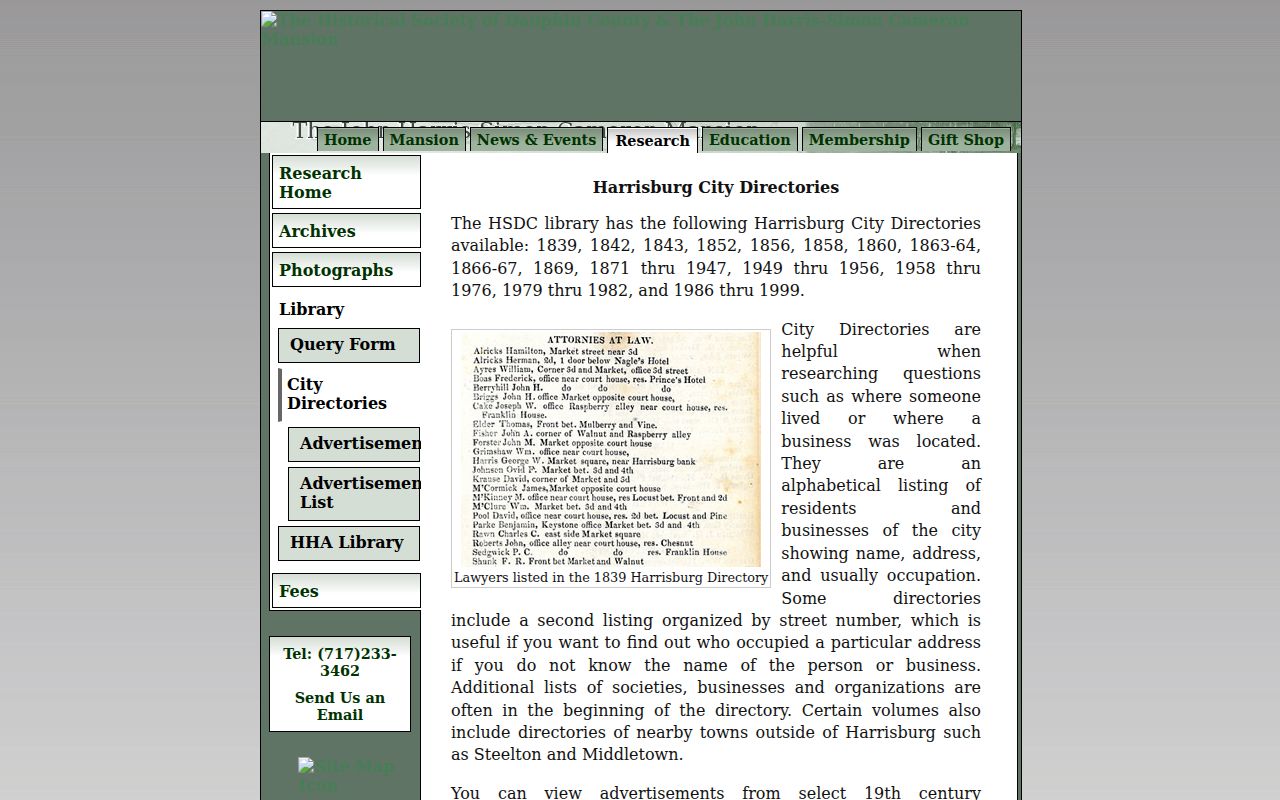
It is a practical first stop because it records the actual Harrisburg directory years rather than implying a continuous run.
Harrisburg Directory Gaps and Local Scope
A volume can reach beyond the city without announcing that fact in a search result. HSDC notes that some of its directories include Steelton and Middletown. Before treating an entry as a Harrisburg residence, inspect the volume title, section heading, and the printed city or town. This check also prevents a business listing, organization list, or paid advertisement from being mistaken for a household entry. Front matter can be rich with leads, but it has a different purpose from the alphabetical resident list.
Mailing geography can add another trap. An old town heading and a present-day postal city are not interchangeable. The USPS ZIP Code Lookup is useful for checking a current address format, but it cannot establish where a historical household lived. Keep the directory transcription intact first, then compare it with a parcel, map, or deed only when the date and place fit.
The captured USPS lookup illustrates the current-address channel that should remain separate from a historic Harrisburg printed entry.
Use postal standardization to test a modern address, then return to the printed directory for the period-specific spelling and number.
Harrisburg City Directories at East Shore
The Dauphin County Library System microfilm collection supplies another local access route: Harrisburg directory volumes for 1861-1901 at East Shore Area Library, 4501 Ethel Street, Harrisburg, PA 17109. That collection is onsite only. Its overlapping years are especially useful when an HSDC inquiry needs a second access point or when a researcher wants to read a run in sequence. DCLS also lists Patriot-News microfilm for 1946-2015, which can help test a dated move, death notice, business change, or civic reference after a directory lead.
Remote access should not be assumed. DCLS has publicized historic newspaper research material, but authentication and availability can change. Call or ask library staff about reader access and the particular reel before relying on it. A photograph or exact note of the title page, page number, and year is stronger than a memory of an entry.
Note: The East Shore microfilm span documents a local access channel, while HSDC remains the source for the broader verified directory-run inventory.
When Harrisburg Directory Shelves End
A directory gap does not end a family-history search. The HSDC archives describe approximately 900 manuscript groups containing family, business, organization, City, and county material. The holdings include letters, diaries, deeds, certificates, ledgers, yearbooks, newspaper clippings, maps, and photographs. HSDC also reports deeds dating to the 1700s and collections connected with the Elder, Harris, Kelker, Cameron, and McCormick families. Those are source groups to request by name, not evidence that every family appears in the archives.
HSDC offers a query and research-service route. Its listed staff-research pricing is onsite $20 per hour with a $40 minimum, offsite $25 per hour with a $50 minimum, and self-directed nonmember research is listed at $10 per day. Confirm every rate, appointment rule, and copying option when requesting work. A focused question works best: give the exact directory year, name variants, address form, and the record group or subject that may fill the gap.
The HSDC archives page is the source for this view of the research-service and manuscript holdings.
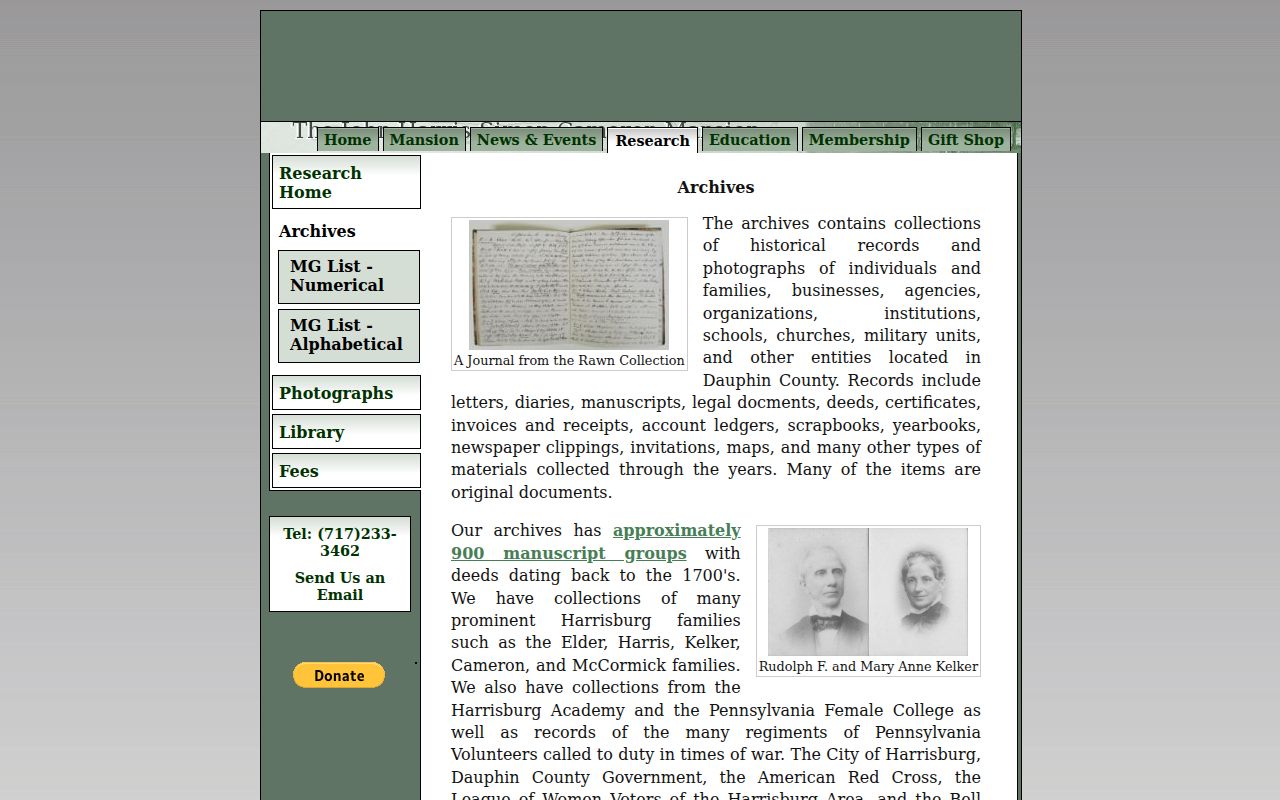
Archives material can bridge a directory gap, but each document needs its own date, collection, and relationship to the household.
Reading a Harrisburg City Directory Entry
Read what is on the page, not a generic model of what a directory ought to say. HSDC supports only that the alphabetical books give a resident or business name, address, and usually occupation. Preserve exact initials, spelling, suffixes, spouse or widow notation, abbreviations, and the year. An occupation can distinguish two people with the same name, yet it is only a year-specific descriptive field. It does not establish a continuing connection. The collection review did not supply a machine-readable full entry, so no person’s line should be silently reconstructed.
| Alphabetical entry | Copy the printed name exactly, including initials, suffixes, and visible spouse or widow notation. |
|---|---|
| Address | Record number, street form, directional prefix, unit or room, and the printed city or town heading. |
| Occupation | Usually present in the HSDC description; use it as a dated distinguishing detail, not a modern identity claim. |
| Street-number listing | Available only in some volumes and useful for an address-to-listed-person or business search. |
| Front matter or advertisement | May identify organizations or businesses, but an ad is not a household-occupancy record. |
- Criss-cross directory
- A street-number arrangement that can lead from an address to a listed person or business when the chosen volume includes it.
- Householder index
- An index arranged around the principal listed household name; its exact treatment must be confirmed in the individual volume.
- Abbreviation key
- The volume’s own explanation of shortened terms. Photograph or transcribe it before expanding a notation.
When a historic address must be linked to land records, use the Dauphin County Recorder’s Acclaim name search as a separate, dated transaction source. The Recorder can help locate recorded parties and document references, but a deed owner is not automatically the directory occupant.
The Recorder name-search interface shows the record channel that can test a property connection after a dated HSDC directory finding.
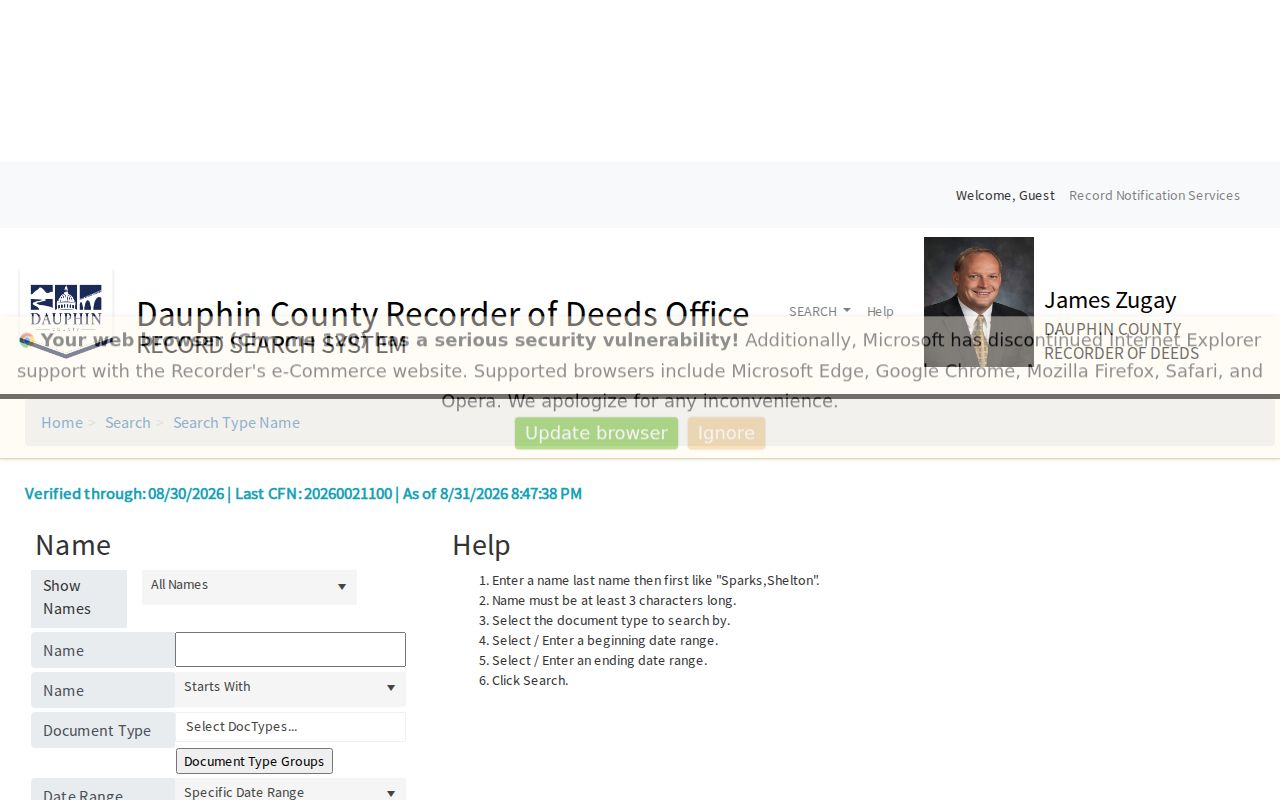
Keep the recorded transaction and the printed listing as separate claims until their dates, address forms, and legal-description context agree.
Harrisburg City Directory Street Listings
Some HSDC books contain a second arrangement by street number. That is the right route when an old address is known but the surname is not. Begin at the address, capture the listed person or business and nearby entries, then verify the name in the alphabetical portion of the same volume. Nearby entries can help reconstruct the order of lots and numbers on a block. They do not create a complete list of every person living there. Vacancies, apartments, compilation methods, and publication timing all limit what an entry proves.
A historic number also needs an era check. Harrisburg’s City Historic Preservation guidance gives one documented example: current 107-109 Cumberland appears as 109-111 on the 1890 map. There is no verified universal citywide renumbering year. Compare the printed street form with the legal description, parcel context, adjacent streets, and the relevant historic map rather than forcing an old number into a current address.
Note: Treat a reverse listing as a dated directory observation, then use parcel and map evidence to test whether the historic address is the same place.
Harrisburg Directories, Maps, and Census Records
Each source answers a different question. A printed directory can place a listed name or business at an address in a published year. The Library of Congress Harrisburg Sanborn volume, dated 1929-November 1950 and containing 106 sheets, gives building and street context. It does not name every resident. Federal census schedules can offer household composition, age, relationship, and an address-era check when released under the federal 72-year practice. Neither maps nor census schedules replace the directory entry.
The State Library digital genealogy collection adds local and county histories, directories, warrant maps, church and cemetery records, family histories, and Pennsylvania newspapers. Its Harrisburg Newspapers Index covers birth, death, and marriage notices from 1799-1827 by surname, and its Necrology Scrapbooks provide another local check. HSDC’s Alexander Family Library also has church records, clipping cards, cemetery inventories, Dauphin birth and death cards, and selected will and Orphans’ Court extracts.
Note: A map establishes physical context, a census can test a household, and a directory preserves a dated listing, so record each source separately.
Trace Harrisburg Households Through Directories
Start from an anchor year supported by an address, surname, or other original record. For pre-1900 work, follow only HSDC’s named early volumes. From the later multi-year blocks, move one published volume at a time, noting both absence and presence. Search the alphabetical pages and, when the volume has one, the street-number arrangement. Record alternate street spellings, printed address forms, occupation, and the volume’s geographic scope before you move forward or backward.
- Choose a documented Harrisburg name or address and identify the nearest verified HSDC year.
- Read the alphabetical entry, then the street-number listing when that volume supplies one.
- Move one published volume at a time and log the real collection gaps instead of filling them by assumption.
- Pair the directory years with released census schedules and test an address against maps, deeds, newspapers, obituaries, probate, or cemetery material.
- Return to HSDC, the Recorder, the Register of Wills, or the State Archives for the original custodian record that resolves a conflict.
A name disappearing from a directory volume can mean a move, death, changed listing practice, a missing book, or no entry in that year. The correct response is a dated cross-check, not a conclusion. For modern address-keyed work, the Harrisburg by-street directory follows the county parcel and records chain rather than rebuilding the historical shelf.
Harrisburg City Directories and the Old Eighth Ward
Historic absence can have a city-history explanation. The Old Eighth Ward was a formerly African American, Jewish, and immigrant neighborhood displaced for Capitol Park extensions. Research describes an initial phase around Walnut to North in 1913-19 and later clearance in the 1950s. For an address in that area, a later disappearance from directories or maps may reflect displacement and altered streetscape rather than a simple household move. Pair the relevant directory with ward maps and municipal records before deciding why a listing ends.
Harrisburg’s municipal records are split among current City channels, historic PHMC material, and HSDC collections. HSDC City Collection MG 030 includes assessment and tax material, laws and ordinances, annual reports, and other civic records. The State Archives holds Harrisburg City Archives Collection MG 534 after the City archives transfer. That divided custody is often the right explanation for a missing answer, not a reason to treat the directory shelf as complete.